
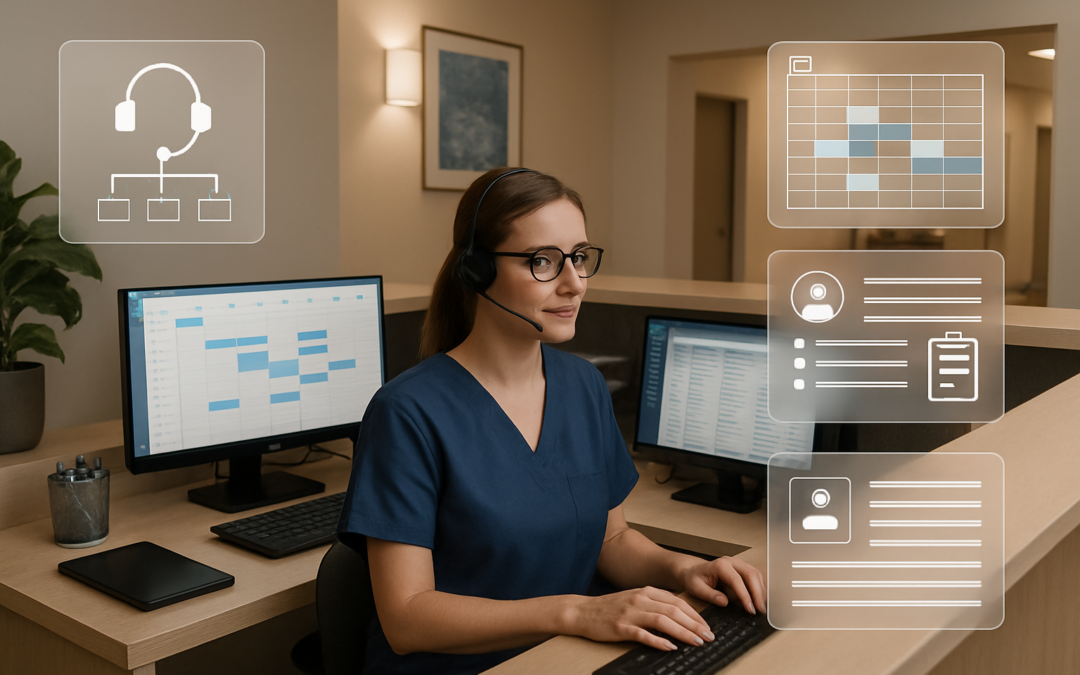
Quick Answer
An AI receptionist for clinics automates 50-70% of routine front desk work—call answering, appointment scheduling, patient intake, and reminders. This frees your human staff for complex patient interactions, reducing overall workload by roughly 50% while improving availability and patient satisfaction simultaneously.
What Your Front Desk Really Needs Right Now
Your reception team is drowning. Between answering calls, scheduling appointments, handling no-shows, and managing patient intake, they’re spread impossibly thin. What if I told you that an AI receptionist for clinics could cut that workload in half without cutting your staff?
The truth is, most clinic owners accept front desk chaos as inevitable. It’s not. Over the past few years, I’ve watched healthcare facilities dramatically improve their operations by deploying intelligent automation at the point of first contact. An AI receptionist for clinics isn’t about replacing people—it’s about freeing them to do work that actually requires human judgment.
How an AI Receptionist Actually Works
Here’s the thing: a modern healthcare AI solution handles the repetitive, high-volume tasks that consume your team’s day. Think appointment scheduling, insurance verification, patient intake forms, and after-hours call routing. The system learns your clinic’s workflows and integrates directly with your existing appointment software and EHR.
What I’ve seen work well is a hybrid approach. The AI handles 70-80% of routine interactions—the calls that follow predictable patterns, the scheduling requests, the reminder confirmations. Your human receptionists focus on complex cases, upset patients, and nuanced decision-making. That’s where your staff’s empathy and judgment actually matter.
The mechanics are straightforward:
- Call handling – AI answers, identifies the caller’s need, schedules appointments or routes to appropriate staff
- 24/7 availability – No more “we’re closed” frustrations; your clinic is always answering
- Data collection – Automated intake, insurance details, and patient history gathering
- Smart routing – Complex cases go to humans; routine tasks complete autonomously
- Follow-up automation – Appointment reminders, pre-visit questionnaires, and post-visit surveys run without human touch
Reducing Workload by 50%: The Real Numbers
Let’s talk specifics. Your front desk typically handles:
Incoming calls: About 40-60% of these are routine—”Can I schedule an appointment?” or “What time does the clinic close?” An AI receptionist handles these instantly.
Appointment scheduling: This is genuinely time-consuming. Your staff manually checks availability, types in details, and often manages back-and-forth messaging. Automated scheduling cuts this to seconds. The AI sees real-time openings and confirms bookings immediately.
Patient intake: Forms that would take 15-20 minutes can be completed digitally before the patient arrives. Your receptionist’s job shifts from data entry to verification.
No-show management: Automated reminders reduce no-shows by 25-40%, which means fewer scrambled reschedules and better staff efficiency.
Here’s the practical impact: A clinic with two full-time receptionists handling 150-200 daily interactions can reallocate roughly one FTE (full-time equivalent) to more valuable work—patient relations, billing follow-up, complex scheduling scenarios. That’s your 50% reduction.
Why Healthcare AI Companies Build These Tools
Robotic Process Automation in Healthcare isn’t new, but the sophistication has changed dramatically. Modern healthcare assistant technology uses natural language processing to understand context, not just keywords. It recognizes when a patient sounds distressed and routes them to a human. It learns your clinic’s terminology. It respects HIPAA requirements built into every interaction.
What separates quality from mediocre: integration depth. A truly effective system doesn’t sit on top of your existing tools—it lives inside them. It talks to your appointment book, your EHR, your billing system. That’s where real efficiency gains happen.
Implementation That Actually Sticks
Rolling out an AI receptionist for clinics requires more than just turning it on. Here’s how to do it right:
- Audit your current workflows – Map exactly what your team does. Which tasks are repetitive? Which take the most time? Which frustrate your staff most?
- Start with your biggest pain point – Don’t try to automate everything at once. If appointment scheduling is chaos, start there. If call volume is killing you, begin with call handling.
- Train your team alongside the AI – Your receptionists need to understand what the system does and doesn’t do. They’re not being replaced; they’re being repositioned.
- Set clear handoff protocols – Define exactly when AI escalates to humans. Clear rules prevent confusion and ensure quality.
- Monitor and adjust continuously – The first month reveals gaps. Build in feedback loops with your staff. They’ll spot issues your system can’t.
- Measure the right metrics – Track call answer time, appointment completion rate, patient satisfaction scores, and staff overtime hours. Not just cost savings.
The Real Benefit: Your Team Gets Their Sanity Back
What most healthcare directors miss is the human side. Your reception team knows when they’re stuck in repetitive drudgery. Burnout at the front desk is real—it’s a high-turnover position with low pay and high stress. An AI receptionist doesn’t just reduce workload; it improves job satisfaction because people spend their day solving problems, not stamping forms.
Patient experience improves too. Think about the last time you called a clinic and waited on hold. That frustration? Gone. Your patients reach someone—human or AI—immediately. They get answers faster. Appointments book instantly. Insurance questions get resolved before they arrive.
Getting Started With AI in Your Clinic
The barrier to entry has fallen significantly. You don’t need a massive IT budget or a complete system overhaul. Custom AI development tailored to your clinic’s specific workflows is increasingly affordable. The key is choosing a partner who understands healthcare—HIPAA compliance, clinical terminology, the rhythm of patient care.
Start with a pilot. Test the AI on a portion of your incoming calls or schedule it for after-hours only. Measure the results. Then expand. Most clinics see positive ROI within 3-6 months as staff time reallocates and patient satisfaction climbs.
Your front desk doesn’t have to be chaos. An AI receptionist for clinics is no longer theoretical—it’s practical, proven, and deployable right now. The question isn’t whether you can afford to implement it. It’s whether you can afford not to.
Frequently Asked Questions
What percentage of front desk work can an AI receptionist actually handle?
Most AI receptionist systems handle 50-70% of routine interactions—appointment scheduling, basic inquiries, intake forms, and after-hours calls. Complex cases, upset patients, and nuanced discussions still require human staff.
Will an AI receptionist replace my front desk staff?
No. Instead, it reallocates their time. Rather than spending 50% of their day on repetitive tasks, staff focus on patient relationships, problem-solving, and complex scheduling. Most clinics shift one FTE to higher-value work rather than eliminating positions.
How does an AI receptionist integrate with existing clinic software?
Quality healthcare AI solutions connect directly to your EHR, appointment book, and billing systems. This integration allows real-time scheduling, insurance verification, and patient data synchronization—the foundation of actual efficiency gains.
What are the main costs associated with implementing an AI receptionist?
Costs typically include software licensing (monthly or annual), initial setup and integration, and staff training. Most healthcare AI implementations cost $500-$2,000 monthly depending on call volume and customization needs.
How long does implementation typically take?
Basic setup takes 2-4 weeks. Full integration with your existing systems and staff training typically takes 6-8 weeks. Most clinics see measurable impact within the first month of operation.
